
Introduction
In Ayurveda, Ama is one of the most fundamental concepts used to explain the origin of disease.
Despite its frequent use, Ama is often misunderstood and loosely translated as “toxins,” which fails to capture its actual physiological significance.
Ama is not a mystical substance, nor does it represent an external poison.
From a scientific standpoint, Ama refers to incompletely processed metabolic material formed due to impaired digestion and metabolism.
Ayurveda considers Ama the earliest pathological stage in the development of most chronic diseases.
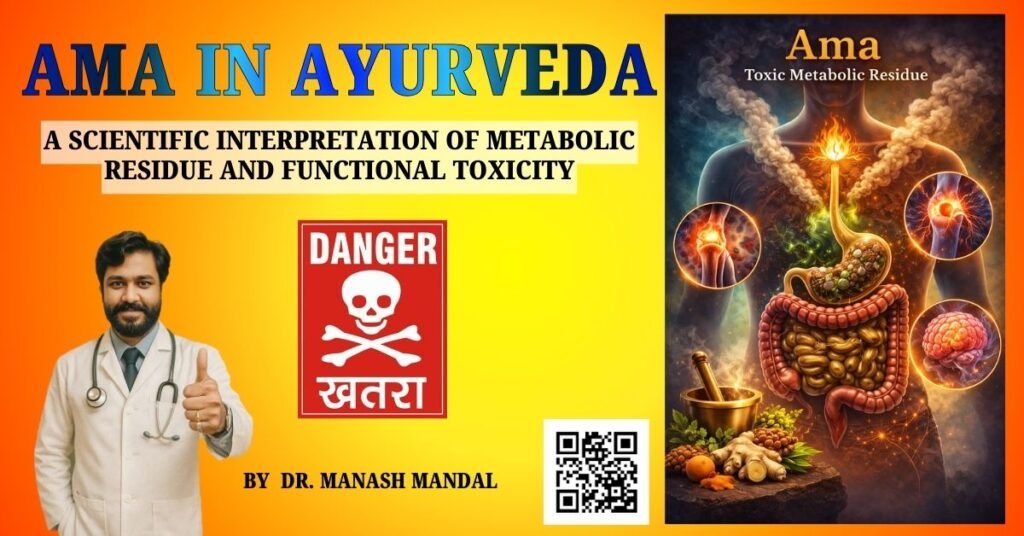
Defining Ama Precisely
Classical Ayurvedic texts describe Ama as a substance formed when Agni (digestive and metabolic fire) becomes weak or irregular.
In functional terms, Ama can be defined as:
Metabolic by-products that are inadequately digested, transformed, absorbed, or eliminated, and therefore remain biologically incompatible with normal tissue function.
Ama is not a single compound.
It is a state of metabolic inefficiency, where partially processed substances interfere with physiological processes.
Mechanism of Ama Formation
1. Impairment of Agni (Mandagni)
Agni governs:
-
Digestion of food
-
Assimilation of nutrients
-
Tissue metabolism
-
Elimination of waste
When Agni becomes weak, irregular, or overloaded, digestion remains incomplete.
2. Incomplete Processing of Nutrients
Partially digested food components remain within the gastrointestinal tract.
These substances are:
-
Heavy and dense
-
Sticky in nature
-
Prone to fermentation
-
Metabolically unstable
This represents the primary stage of Ama formation.
3. Systemic Distribution
Ama does not remain localized in the gut.
It enters systemic circulation and spreads through various Srotas (functional channels), including:
-
Digestive
-
Circulatory
-
Muscular
-
Adipose
-
Nervous systems
Once deposited, Ama disrupts normal tissue metabolism.
Properties of Ama (Functional Characteristics)
Ayurvedic texts describe Ama as possessing the following qualities:
-
Heavy (Guru)
-
Sticky (Picchila)
-
Cold (Sheeta)
-
Dull (Manda)
-
Obstructive
These properties explain why Ama:
-
Slows metabolic activity
-
Obstructs microcirculation
-
Interferes with nutrient delivery
-
Promotes low-grade inflammation
Correlation with Modern Biomedical Concepts
Ama does not correspond to a single laboratory parameter.
However, it overlaps with several recognized modern phenomena, such as:
-
Chronic low-grade inflammation
-
Gut microbiome imbalance
-
Endotoxin overload
-
Metabolic waste accumulation
-
Impaired mitochondrial efficiency
Thus, Ama represents a functional metabolic pathology, often present before structural disease becomes detectable.
Role of Ama in Disease Development
Ayurveda states that disease does not manifest without the involvement of Ama.
Clinically, this means:
-
Ama creates a favorable internal environment for disease
-
It weakens tissue resistance
-
It disrupts immune and metabolic signaling
Conditions commonly associated with Ama include:
-
Metabolic disorders
-
Digestive dysfunctions
-
Joint and musculoskeletal disorders
-
Chronic inflammatory skin conditions
Early neurological complaints
Why Ama Is Not the Same as “Toxins”
The term “toxins” implies externally introduced poisons.
Ama differs fundamentally because:
-
It is internally generated
-
It is dynamic and reversible
-
It reflects metabolic inefficiency, not poisoning
Ama is better understood as functional metabolic residue rather than toxic contamination.
Clinical Indicators of Ama
Common signs suggesting the presence of Ama include:
-
Persistent heaviness in the body
-
Loss of appetite or irregular hunger
-
Indigestion or bloating
-
Coated tongue
-
Foul-smelling stools
-
Unexplained fatigue
-
Mental dullness or brain fog
-
Morning stiffness in joints
These signs often appear before abnormal laboratory findings.
Gastrointestinal Origin of Ama
The digestive system is the primary site of Ama formation.
Factors contributing to Ama include:
-
Overeating
-
Eating before previous meals are digested
-
Irregular meal timing
-
Excessive intake of heavy, cold, or processed foods
-
Chronic psychological stress
-
Inadequate sleep
Modern parallels include impaired enzyme activity, altered gut motility, and microbiome disruption.
Progression from Ama to Chronic Disease
If Ama is not addressed early:
-
It combines with Doshas
-
It lodges in susceptible tissues
-
Chronic inflammation develops
-
Structural disease follows
This explains why Ayurveda emphasizes early metabolic correction rather than late-stage symptomatic treatment.
Ayurvedic Principles for Managing Ama
Ayurveda does not aim to forcibly eliminate Ama.
Management follows a logical sequence:
1. Restoration of Agni
Without correcting digestion, Ama will continue to form.
2. Metabolic Processing of Existing Ama
This involves dietary regulation, lifestyle modification, and targeted therapeutic measures.
3. Clearing Functional Obstruction
As Ama reduces, tissue nutrition and circulation improve.
4. Long-Term Prevention
Stable digestion, regular routine, and stress regulation prevent recurrence.
Treatment is always individualized based on constitution and disease stage.
Conclusion
Ama is not a symbolic or outdated concept.
It represents a functional model of metabolic dysfunction that aligns closely with modern understandings of chronic disease development.
By identifying Ama early, Ayurveda offers a preventive framework that intervenes before irreversible pathology occurs.
This makes Ama one of the most clinically relevant and scientifically compatible concepts within Ayurvedic medicine.
Call to Action
If you experience:
-
Chronic fatigue
-
Indigestion
-
Heaviness in the body
-
Recurrent symptoms without clear diagnosis
An Ayurvedic assessment focusing on Agni and Ama may help identify the root cause.
🌿 Nirmala Ayurveda Veshaj, Falakata
💻 Online consultation available
📲 WhatsApp: 916291957581
Correcting metabolism early is the foundation of long-term health.